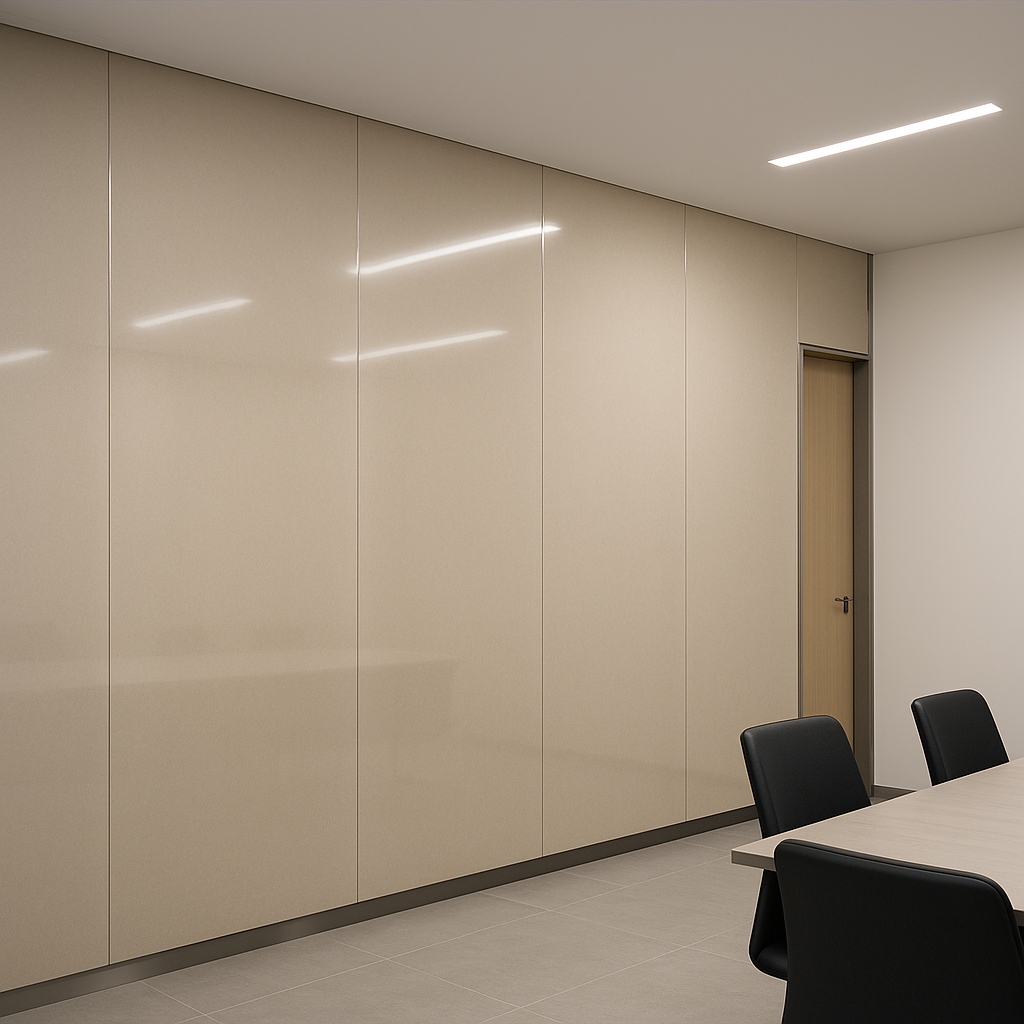
Why Hospitals Choose Thin Porcelain Panels
Large clinical interiors need finishes that are durable, easy to disinfect, and compliant with strict fire and hygiene codes. Thin porcelain wall panels deliver a dense, non-porous surface that resists peroxide-based and other hospital-grade cleaners. Fewer vertical joints reduce grime traps, supporting infection-control routines and faster daily cleaning. Their A1 non-combustible rating helps meet interior fire-safety requirements in healthcare facilities.
Key Specifications for Healthcare Fit-Outs
- Thickness: 6 mm (project-standard for walls: strength with low weight).
- Sizes: 1200×2400 / 1200×2700 / 1200×3000 mm (custom on request).
- Surface: Mirror-glaze by default (high-cleanability); satin available for glare-sensitive areas.
- Joints: Vertical-only 3–4 mm reveals; no horizontal joints for floor-to-ceiling modules.
- Edges & trims: 304 stainless L-trim on external corners; micro-bevel (≈0.3–0.6 mm).
- Hygiene: Dense porcelain body, very low water absorption; easy wipe-down after daily rounds.
- Fire: A1 non-combustible (documentation provided on request).
- Colors & looks: Solid whites/greys for clinical zones; wood-look or stone-look for family areas.
Faster Retrofits with Less Demolition
At 6 mm and ~11–13 kg/m², thin panels load the structure far less than stone and can be installed over sound substrates (tile-over-tile where appropriate), cutting noise, dust and programme time. Typical hospital retrofit benefits: fewer trades, overnight shifts possible in corridors, quick patient-area turnover.
Installation Overview (Walls)
- Substrate prep: Plumb and true; check adhesion of existing finishes if tiling over tile.
- Adhesive & layout: High-performance deformable tile adhesive (e.g., C2TES2 class), full-coverage troweling.
- Panel handling: Vacuum lifters or A-frame trolleys; dry fit, then set plumb with 3–4 mm vertical reveals.
- Trims & sealing: Stainless L-trims on corners; healthcare-grade sealant at perimeter and terminations.
- QA & cleaning: Remove protective film after punch list; handover with cleaning & care sheet.
Ask us for our detailed installation method statement (IMS) and sample fixing details for nurse stations, bed-head walls and ICU partitions.

Compliance Package (on request)
- Fire classification (A1 non-combustible).
- Low-VOC/indoor-air statements.
- Porcelain tile/panel conformity (EN/BS/ASTM equivalents).
- Chemical-resistance notes for hydrogen-peroxide/nebulized disinfectants.
- Edge/trim metal specs and stainless grades.
Hospital Use-Cases
- Clinical corridors & waiting areas: bright, wipe-clean, impact-tolerant.
- Isolation & ICU rooms: low joint count simplifies disinfecting routines.
- Nurse stations & treatment rooms: durable, premium look with optional wood-look accents for warmth.
- Public lobbies: large-format slabs create a calm, seamless visual field that improves wayfinding graphics.
Packaging & Logistics
Panels ship on steel A-frames/U-racks with corner guards and protective film. Export cartons and crate bracing are optimized for sea freight; project labeling by room/zone can be provided to speed onsite distribution. We regularly load consolidated containers for AU/NZ, GCC and UK routes.
FAQs
Q1. Can panels be cut for sockets and medical rails?
Yes—CNC or water-jet fabrication; onsite adjustments with suitable blades and jigs.
Q2. Are they suitable for wet areas?
For wet walls and splash zones, use porcelain panels with sealed perimeters and appropriate waterproofing behind.
Q3. How do we match your standard 1200 mm module to ceiling heights?
We supply 2400/2700/3000 mm; minor height variations are handled with ceiling shadow gaps or base reveals.