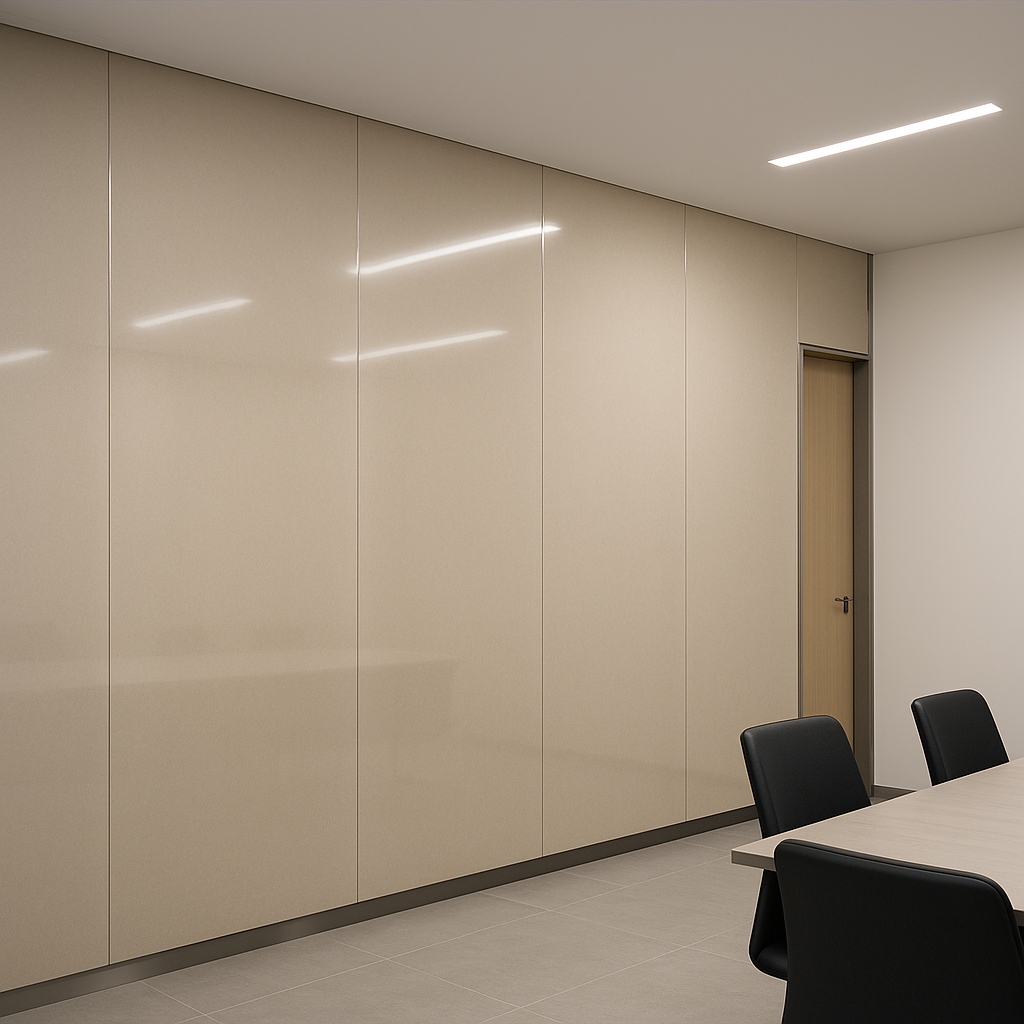
From Powder to Panel: The 1200 °C Journey of 6 mm Thin Porcelain Wall Panels
Outline
- What makes a porcelain wall panel “porcelain”
- Raw minerals and body preparation
- High‑tonnage pressing for a 6 mm body
- Controlled drying and green stability
- Glazing & digital decoration (mirror glaze as standard)
- Roller‑kiln firing at ≈1200 °C: sintering & vitrification
- Dimensional stability, warpage control, and planarity
- Surface finishes & slip/cleanability notes
- QA checkpoints and indicative performance
- Specification checklist for design teams
- Sector implications (healthcare, education, transit/airports)
- Packaging & logistics snapshot
- Conclusion + next steps
What “Porcelain” Really Means for Wall Panels
In architectural ceramics, porcelain is defined by a vitrified microstructure with very low water absorption, delivering stain resistance, hygiene, and dimensional stability. For 6 mm thin porcelain wall panels (often called thin porcelain panels or porcelain wall panels), the manufacturing route is deliberately engineered to achieve a dense body at a relatively thin section without compromising rigidity.
Opinion: For genuine porcelain performance, peak firing around 1200 °C in a roller kiln is not optional—it is essential. Lower firing regimes tend to leave a more open matrix, which can reduce resistance to staining and chemicals over time.
(Terminology note: Some markets use “sintered stone” loosely. Technically, our product is a porcelain ceramic: a kaolin–feldspar–quartz body fired to vitrification.)
Raw Minerals & Body Preparation
The recipe typically combines:
- Kaolin for plasticity and white firing behavior,
- Feldspar as a flux to promote vitrification,
- Quartz (silica) for skeletal strength and thermal stability,
with selected additives for rheology and green strength.
Wet milling creates a uniform slip; spray drying transforms it into free‑flowing granulate with carefully controlled moisture. This granule morphology is critical for even die fill during pressing—an early investment that pays dividends in flatness and thickness accuracy later.
High‑Tonnage Pressing: Building a 6 mm Backbone
Large‑format panels (e.g., 1200 × 3000 mm at 6 mm thickness) demand tight control of particle packing. High‑tonnage hydraulic presses compact the spray‑dried granules to achieve a high green density. The target is a uniform backbone: edges as consistent as the center, so the eventual fired panel exhibits minimal camber and tight thickness tolerance suitable for precise stainless L‑trim finishes and 3–4 mm vertical joints on the wall.
Controlled Drying & Green Stability
Post‑press drying removes residual moisture without inducing differential stresses. Evenness matters more than speed. The goal is to present the roller kiln with a flat, crack‑free green body ready for glaze and decoration—the best insurance policy against warpage downstream.
Glazing & Digital Decoration (Mirror Glaze as Standard)
Our mirror‑gloss glaze is the default for a bright, easily cleanable skin. After glazing, high‑resolution digital printing (where specified) adds color or pattern with ceramic inks that fuse permanently during firing. The glaze also acts as a protective cap, sealing the surface against chemical agents used in hospitals and transport hubs.
Roller‑Kiln Firing at ≈1200 °C: Sintering & Vitrification
The roller kiln is the heart of the process. A typical curve includes:
- Pre‑heat: to gently pass the quartz inversion and drive off volatiles,
- Soak near 1200 °C: where feldspathic phases flow and bind the matrix,
- Controlled cool: to lock in microstructure and minimize residual stress.
At peak, the body sinters and partially vitrifies. Porosity collapses, mineral phases interlock, and the glaze fuses to a glass‑ceramic surface. The result is a thin, dense panel with low water absorption, stable color, and excellent cleanability. This is why porcelain panels hold their polish, resist stains, and shrug off daily disinfecting routines.
Dimensional Stability & Warpage Control
Two levers define flatness: composition and thermal curve. We tune both. Shrinkage is predicted and compensated through tooling and process set‑points; inline laser checks and post‑fire sorting remove outliers. The outcome is planarity that supports tight, vertical‑only 3–4 mm joints and precise reveals at corners with 304 stainless L‑trim—hallmarks of premium installation.
Surface Finishes, Slip & Cleanability
While mirror‑gloss is standard, matte and micro‑textured finishes are available for areas needing reduced reflectance. Regardless of finish, porcelain chemistry delivers:
- Non‑porous, low‑absorption surface,
- Resistance to common cleaners and disinfectants,
- Colorfastness under typical interior lighting.
QA Checkpoints & Indicative Performance
A disciplined QA plan spans:
- Dimensional checks: length, width, thickness uniformity,
- Flatness/camber screening, visual inspection under neutral 4000 K light,
- Surface tests: gloss, abrasion, and stain resistance appropriate for walls,
- Bond compatibility: test with approved adhesives for 6 mm panels,
- Edge integrity: to ensure safe handling and clean L‑trim terminations.
Typical porcelain properties include very low water absorption and excellent chemical resistance. For project submittals, always rely on the current Technical Data Sheet (TDS) and mock‑up results.
Specification Checklist for Design Teams
- Panel format: common module 1200 mm (e.g., 600 × 1200; 1200 × 2400; 1200 × 3000 mm); thickness 6 mm.
- Joints: vertical‑only, 3–4 mm recommended; avoid horizontal joints for seamless floor‑to‑ceiling effect.
- Corners/edges: 304 stainless L‑trim, color‑matched sealant.
- Substrate: plumb, load‑bearing wall or approved board; plan expansion joints per design.
- Adhesives: high‑performance cementitious or hybrid systems rated for large‑format porcelain; back‑butter as specified.
- Hygiene & cleaning: neutral pH cleaners; avoid waxes that increase soil retention.
Sector Implications
Healthcare: Non‑porous, chemically robust, and smooth—ideal for patient corridors, procedure suites’ clean areas, nurse stations, and wall cladding behind hand‑wash stations. Tight vertical joints and mirror glaze help minimize grime traps.
Education (schools/campuses): Durable wall skins for high‑traffic halls, atria, and lobbies. Grafitti resistance and easy cleaning protect long‑term appearance with minimal maintenance.
Transit/Airports: Hard‑wearing cladding for terminals and concourses—resists scuffs from luggage and frequent cleaning cycles, keeping wayfinding zones bright and legible.
Packaging & Logistics Snapshot
Panels are stacked on steel A‑frames with foam spacers and edge protectors, strapped and film‑wrapped. Crates are labeled for upright handling. Recommended handling uses vacuum lifters or spreader bars with multi‑point slings. Site delivery includes route planning for large‑format access and vertical storage near the install area.